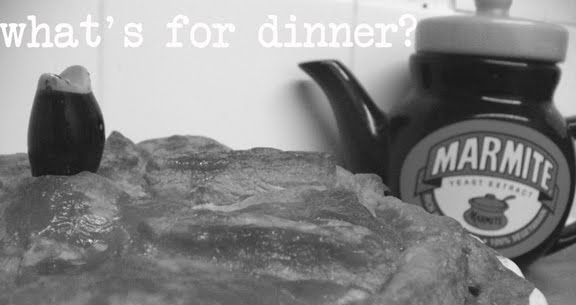
This week has been absolutely slammed with no real time for grocery shopping or enjoying the cooking, and last night's dinner kind of showed it. I mean, it was edible, but it needs work.
Canned tuna steak (in oil, not brine, drained and rinsed)
1 onion
1 green pepper
1 courgette
Handful dry cured black olives
Garlic
Carton of passata
Handful of chestnut mushrooms
Italian herbs
Mozzarella (a sprinkle)
Breadcrumbs (a sprinkle)
Spaghetti, cooked
So. In a pan, saute off the onions, adding the garlic after a couple of minutes, and then the rest of the chopped vegetables. Put the lid on and allow to soften while you put the oven on to 180 degrees and set the pasta to cook. When the vegetables and garlic are looking squidgly, add the drained tuna, break it up well it a fork, and add the passata and herbs. Allow this to cook through for a few minutes while the pasta finishes.
When the pasta's cooked, drain it well and add it to the sauce, tossing thoroughly to make sure everything's coated. Spoon about half into a pyrex oven dish, sprinkle with mozzarella, then add the rest with another sprinkle of mozzarella and a light shake of breadcrumbs for a lovely crispy top. Stick it in the oven for 20 minutes, and then eat.
I think it needs a more liquid and possibly some extra tomato puree but it wasn't bad and we were hungry.
Thursday, 28 January 2010

Tuesday, 26 January 2010
Leftover pork
Obviously a shoulder of pork was a lot of meat for three people so we had leftovers for dinner last night. Here is what I made.
Leftover pork, with fat carefully removed
1 onion
1 green pepper
garlic
1 carton passata
1 pack of baby spinach
handful of dry cured pitted black olives
Italian herb seasoning
Black pepper
About a quarter of a lemon
First, warm a teeny glob of butter in the pan and add the pork. Warm through gently and let it get some moisture back into it. Then, add the chopped onions and sweat off gently. Next in is the garlic and the green pepper, and then let things cook together while you chop the olives- they can go in next. Add the passata, herbs, black pepper and lemon, and pop a lid on while you decide what you're having with this; gnocchi or pasta? We went for gnocchi last night but I think I'd rather have had pasta in retrospect. Anyway. Cook the pasta and when it's almost ready pop the spinach in with the sauce, stir through, turn off the heat and stick the lid on so it wilts into the sauce. Drain your pasta (or gnocchi) and stir into the sauce, et voila! We had a sprinkle of mozzarella on top, and it was a good foil for the olives and pork.
Leftover pork, with fat carefully removed
1 onion
1 green pepper
garlic
1 carton passata
1 pack of baby spinach
handful of dry cured pitted black olives
Italian herb seasoning
Black pepper
About a quarter of a lemon
First, warm a teeny glob of butter in the pan and add the pork. Warm through gently and let it get some moisture back into it. Then, add the chopped onions and sweat off gently. Next in is the garlic and the green pepper, and then let things cook together while you chop the olives- they can go in next. Add the passata, herbs, black pepper and lemon, and pop a lid on while you decide what you're having with this; gnocchi or pasta? We went for gnocchi last night but I think I'd rather have had pasta in retrospect. Anyway. Cook the pasta and when it's almost ready pop the spinach in with the sauce, stir through, turn off the heat and stick the lid on so it wilts into the sauce. Drain your pasta (or gnocchi) and stir into the sauce, et voila! We had a sprinkle of mozzarella on top, and it was a good foil for the olives and pork.
Sunday roast, and how to make gravy
Well, despite being quite an experienced cook I had never roasted a joint of pork before, so on Sunday, feeling the need for something huge to make us sleep through all the FA Cup 4th round matches in the afternoon, I set out to roast a pork shoulder.
The roasting was, of course, no problem, and the meat came out great. One question though: the gravy. My mother served us roast pork just after new year and her assertion that roast pork gravy is the best was not wrong, so I called her to get directions (just in case). Here, for all to see, are Joy Duckett's Instructions For Roast Pork Gravy.
1. You need to be making some form of potatoes to go with the gravy. You need the boiling water with all the gluey starch in it.
2. When the pork's done, take it out of the roasting tray (I've got one with a little rack so the juices run away from the meat). Put it to one side to rest. Drain the water from the potatoes into the roasting tray and put onto a low heat (obviously, no handle, so hang onto it with a tea towel or something).
3. I had some onions that I'd already sauteed with some balsamic vinegar (just a teeny splash) - those can go in, too
4. When you're ready, if you like, thicken the mixture with a cornflour/water paste; some folks like their gravy thick enough to spread (my flatmate being one of them), others like more of a jus, but both are good as long as there's no lumps!
And that is how you make roast pork gravy like my mum.
The roasting was, of course, no problem, and the meat came out great. One question though: the gravy. My mother served us roast pork just after new year and her assertion that roast pork gravy is the best was not wrong, so I called her to get directions (just in case). Here, for all to see, are Joy Duckett's Instructions For Roast Pork Gravy.
1. You need to be making some form of potatoes to go with the gravy. You need the boiling water with all the gluey starch in it.
2. When the pork's done, take it out of the roasting tray (I've got one with a little rack so the juices run away from the meat). Put it to one side to rest. Drain the water from the potatoes into the roasting tray and put onto a low heat (obviously, no handle, so hang onto it with a tea towel or something).
3. I had some onions that I'd already sauteed with some balsamic vinegar (just a teeny splash) - those can go in, too
4. When you're ready, if you like, thicken the mixture with a cornflour/water paste; some folks like their gravy thick enough to spread (my flatmate being one of them), others like more of a jus, but both are good as long as there's no lumps!
And that is how you make roast pork gravy like my mum.
Sunday, 24 January 2010
Peanut cookies
Oh...dear.
I received a replacement copy of Baking and the Art of Comfort Cooking, by Nigella Lawson, for Christmas - one of my all time favourite baking recipe books. Whilst slumped flicking through it last night, my eye fell on these little beauties, and they've just come out of the oven.
100g unsalted butter
50g vegetable shortening, ie Trex
1 large egg
75g light muscovado sugar, plus extra for dusting
1 teaspoon vanilla extract
175g self raising flour
125g salted peanuts
2 baking sheets (lined)
Preheat the oven to 190 degrees.
In a bowl mix the butter, shortening, sugar, egg and vanilla extract til it's all creamed together. Then sieve in the flour and stir in that and the peanuts. The dough is ready!
Drop teaspoonsfull onto the prepared baking sheets but leave about 5cm between because these SPREAD. I managed about 12 per tray. Then oil the bottom of a drinking glass (I used sesame oil), dip it into the reserved sugar, and flatten each dollop a bit.
Bake for 8-10 minutes and then leave to cool on a wire rack.
Edit: These come out quite fragile, or at least mine did. Try to restrain yourself from shovelling half the batch in while you're putting them on the wire rack. I can now see why Nigella says in her book that from the point of view of sheer greediness, these are her favourite; they're GENIUS. And very moreish.
I received a replacement copy of Baking and the Art of Comfort Cooking, by Nigella Lawson, for Christmas - one of my all time favourite baking recipe books. Whilst slumped flicking through it last night, my eye fell on these little beauties, and they've just come out of the oven.
100g unsalted butter
50g vegetable shortening, ie Trex
1 large egg
75g light muscovado sugar, plus extra for dusting
1 teaspoon vanilla extract
175g self raising flour
125g salted peanuts
2 baking sheets (lined)
Preheat the oven to 190 degrees.
In a bowl mix the butter, shortening, sugar, egg and vanilla extract til it's all creamed together. Then sieve in the flour and stir in that and the peanuts. The dough is ready!
Drop teaspoonsfull onto the prepared baking sheets but leave about 5cm between because these SPREAD. I managed about 12 per tray. Then oil the bottom of a drinking glass (I used sesame oil), dip it into the reserved sugar, and flatten each dollop a bit.
Bake for 8-10 minutes and then leave to cool on a wire rack.
Edit: These come out quite fragile, or at least mine did. Try to restrain yourself from shovelling half the batch in while you're putting them on the wire rack. I can now see why Nigella says in her book that from the point of view of sheer greediness, these are her favourite; they're GENIUS. And very moreish.
Spiced fruit soda bread

While the fridge bottom soup was cooking, this was in the oven. It's taken from a Hugh Fearnley-Whittingstall recipe in the 2010 River Cottage Diary, and since it came out completely perfect I'm just going to repeat the recipe here.
250g plain flour
250g wholemeal flour
2.5 tsp bicarbonate of soda
Pinch of salt
3 tbsp caster sugar
200g mixed dried fruit
1 tsp cinnamon
400ml buttermilk
Pre-heat the oven to 230 degrees first.
Mix all the dry ingredients in a bowl, make a well in the centre, and pour in the buttermilk. Mix together until it makes a soft sticky dough and then turn out onto a floured surface and knead lightly for a minute until it comes together into a proper ball.
Put it into the tin and bake for about ten minutes, then turn the heat down to 200 degrees and cook it for abother 25 minutes or so. It's done when it sounds hollow.
Nice eh?

Fridge-bottom soup
This sounds pretty horrid but actually it's how I use up all the ends of last week's vegetables and make lunch for the week. It's a lot nicer than sandwiches and particularly in cold weather, a welcome change.
Obviously the vegetables will change week by week but the basic premise is: everything you've got left over, plus some stock and tomatoes, plus lentils and whatever flavouring you fancy.
Today's soup consists of:
3 rashers of leftover smoked bacon
1 onion
1 sad leek
1 red pepper
1 head of celery that was looking a bit floppy
half a bag of grated carrot
1 slightly bashed courgette
half a pack of mushrooms (about six)
Garlic, plenty
small carton of passata
chicken stock
Italian herb seasoning
salt and black pepper
a bay leaf
about 300g red lentils
It's the same basic process as usual: crisp up the bacon, sweat off the onions, celery and carrots for a few minutes, add the garlic, allow it to cook in for a few more minutes, and then add all the chopped veg, pop the lid on and leave them for about ten minutes or so to get a bit tender.
Then add the passata, herbs, seasoning and bay leaf, give it five minutes and then the lentils, followed by the stock. Stick the lid on and leave it to do its thing for about half an hour, with periodic stirring - and you're done.

See, it doesn't look nearly as grim as it sounds!
PS - DON'T FORGET TO FISH OUT THE BAY LEAF!
Obviously the vegetables will change week by week but the basic premise is: everything you've got left over, plus some stock and tomatoes, plus lentils and whatever flavouring you fancy.
Today's soup consists of:
3 rashers of leftover smoked bacon
1 onion
1 sad leek
1 red pepper
1 head of celery that was looking a bit floppy
half a bag of grated carrot
1 slightly bashed courgette
half a pack of mushrooms (about six)
Garlic, plenty
small carton of passata
chicken stock
Italian herb seasoning
salt and black pepper
a bay leaf
about 300g red lentils
It's the same basic process as usual: crisp up the bacon, sweat off the onions, celery and carrots for a few minutes, add the garlic, allow it to cook in for a few more minutes, and then add all the chopped veg, pop the lid on and leave them for about ten minutes or so to get a bit tender.
Then add the passata, herbs, seasoning and bay leaf, give it five minutes and then the lentils, followed by the stock. Stick the lid on and leave it to do its thing for about half an hour, with periodic stirring - and you're done.

See, it doesn't look nearly as grim as it sounds!
PS - DON'T FORGET TO FISH OUT THE BAY LEAF!
Saturday, 23 January 2010
Useful equipment
I don't have loads and loads of fancy kitchen equipment.
Here's my list:
One large heavy bottomed metal pan with a lid that can go into the oven
One elderly Kenwood hand mixer that is older than me (and I was born in 1978!) and belonged to my mum
One small Braun hand blender that cost me a tenner from ASDA
Wooden spoons x 3
Set of sharp knives - vegetable knife, bread knife, carving knife, paring knife
Scissors
Can opener
Peeler
Mixing bowl
Chopping board
Set of scales
Sieve
Measuring cups and spoons and a jug
I've also got a few Pyrex oven dishes and cheap oven trays. You don't need to get expensive ones, just get a silicone sheet to line them with for about £3 and then wash it. Bingo.
I also use a set of silicon baking moulds - no need for paper cases or farting about greasing and lining stuff. Easy.
Here's my list:
One large heavy bottomed metal pan with a lid that can go into the oven
One elderly Kenwood hand mixer that is older than me (and I was born in 1978!) and belonged to my mum
One small Braun hand blender that cost me a tenner from ASDA
Wooden spoons x 3
Set of sharp knives - vegetable knife, bread knife, carving knife, paring knife
Scissors
Can opener
Peeler
Mixing bowl
Chopping board
Set of scales
Sieve
Measuring cups and spoons and a jug
I've also got a few Pyrex oven dishes and cheap oven trays. You don't need to get expensive ones, just get a silicone sheet to line them with for about £3 and then wash it. Bingo.
I also use a set of silicon baking moulds - no need for paper cases or farting about greasing and lining stuff. Easy.
Subscribe to:
Posts (Atom)

